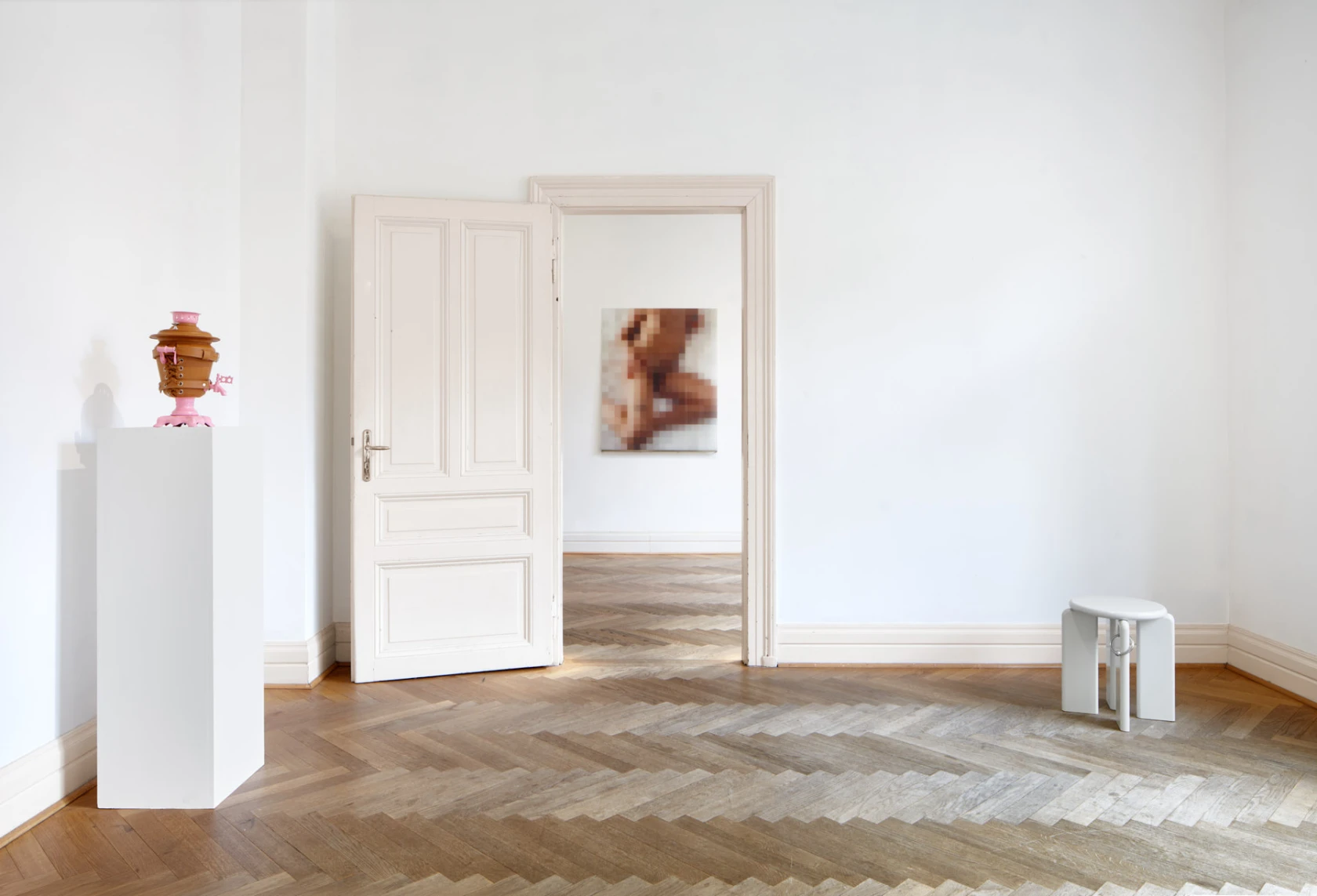
The work “M.” (ceramic ink print on glass) depicts a pixelated body whose gender and identity remain ambiguous, using the digital glitch to disrupt expectations of how bodies should be read and categorised.
Where do we feel at home? That is the central question artist and designer Gregor Jahner asked himself when conceiving the works for his recent solo-show debut at Galerie Jean Claude-Maier in Frankfurt, Germany. It is a deeply individual one, yet one that connects us all. And from a queer perspective, it takes on another dimension: LGBTQ+ youth are more than twice as likely to experience homelessness as their non-LGBTQ+ peers. But home is not merely a question of place. It is also a feeling of togetherness. Many queer people know the feeling of not belonging, whether to a space or a concept of how one is supposed to live. Curated by Mahret Ifeoma Kupka, “Coming Home” by Gregor Jahner unravels these sometimes heavy topics with remarkable ease.
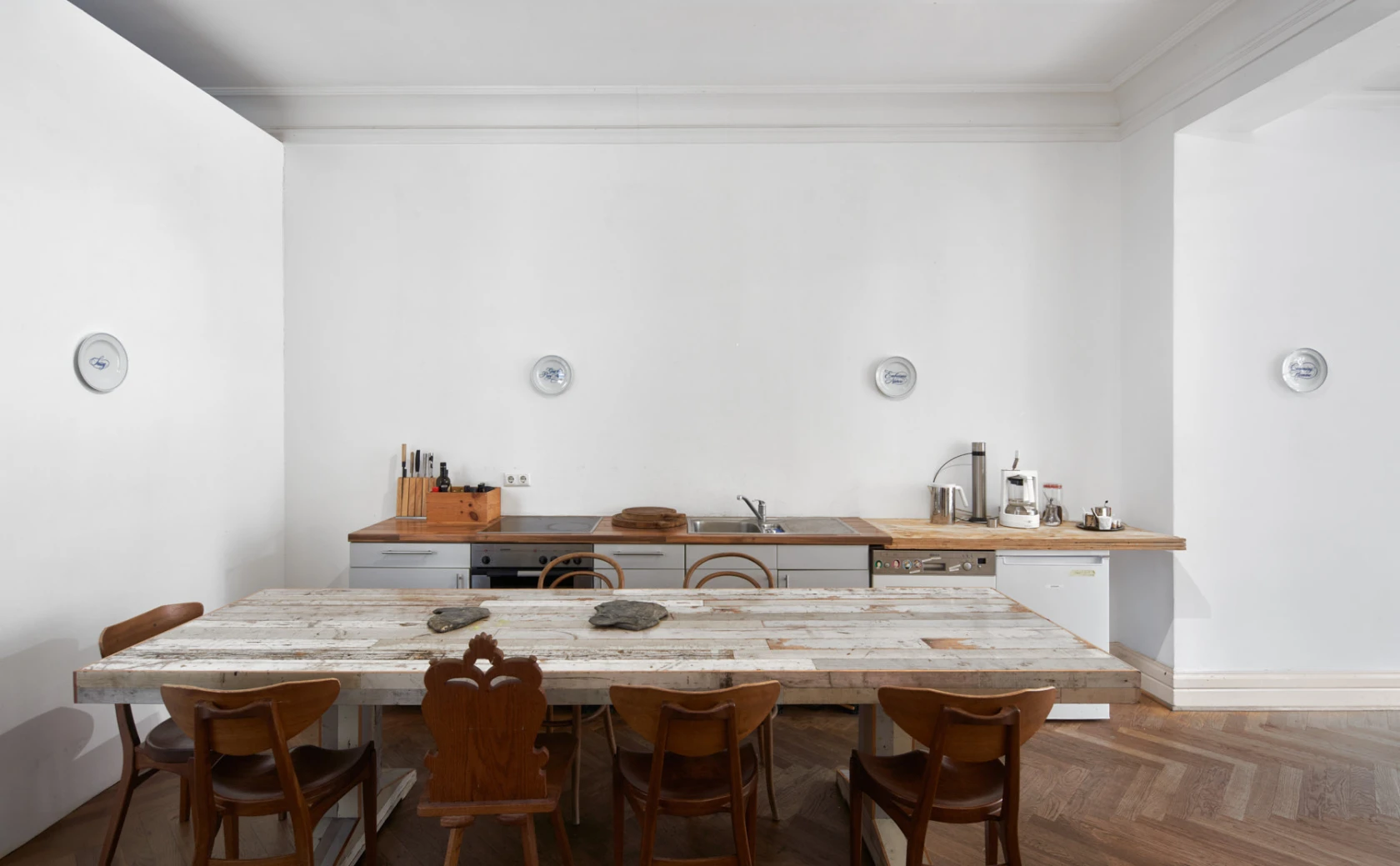
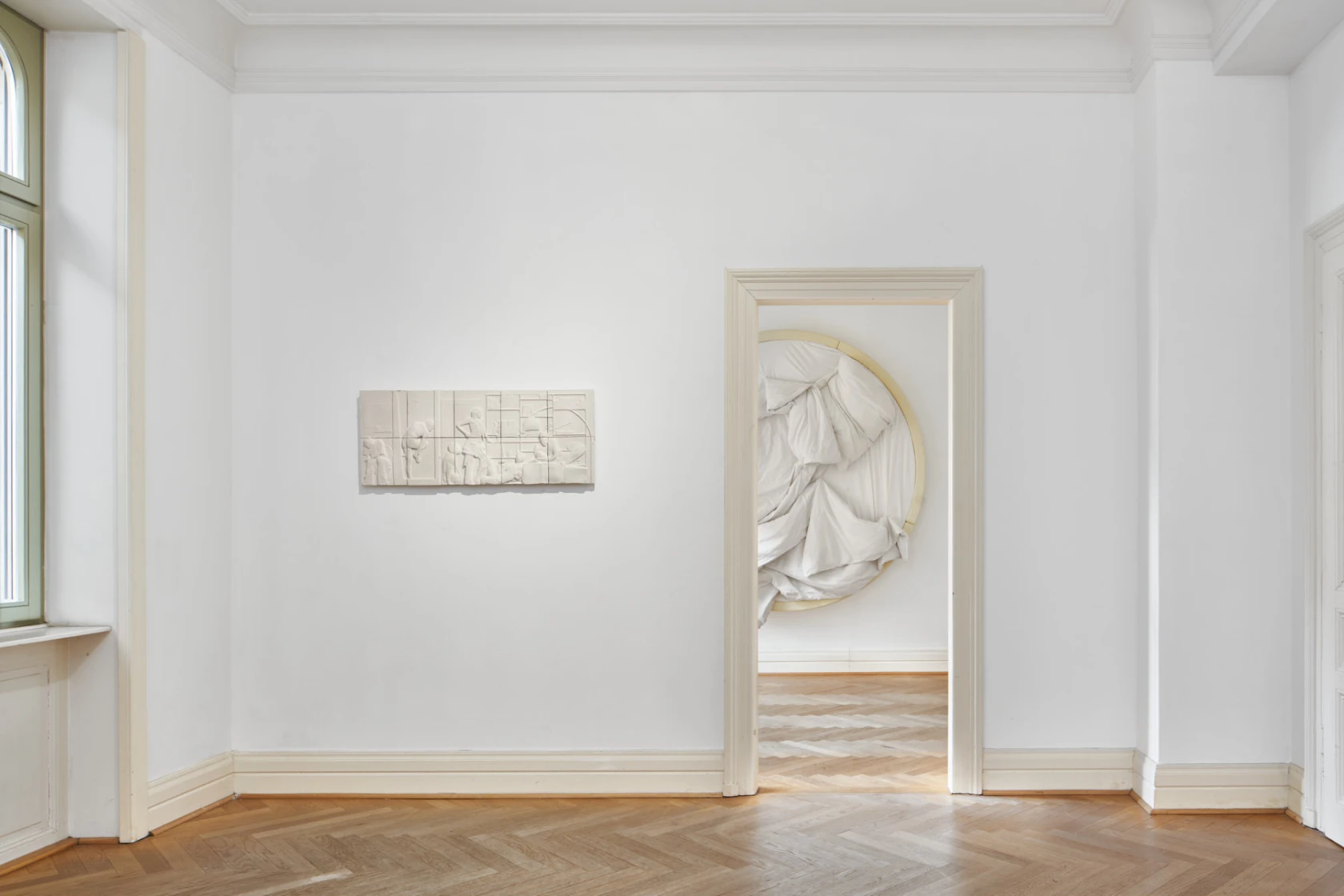
Housed in a classic Frankfurt Altbau with wooden floors, panelled doors, and stucco ceilings in the city’s notorious Bahnhofsviertel, the exhibition unfolds in a gallery that resembles a cosy apartment more than a sterile white cube.
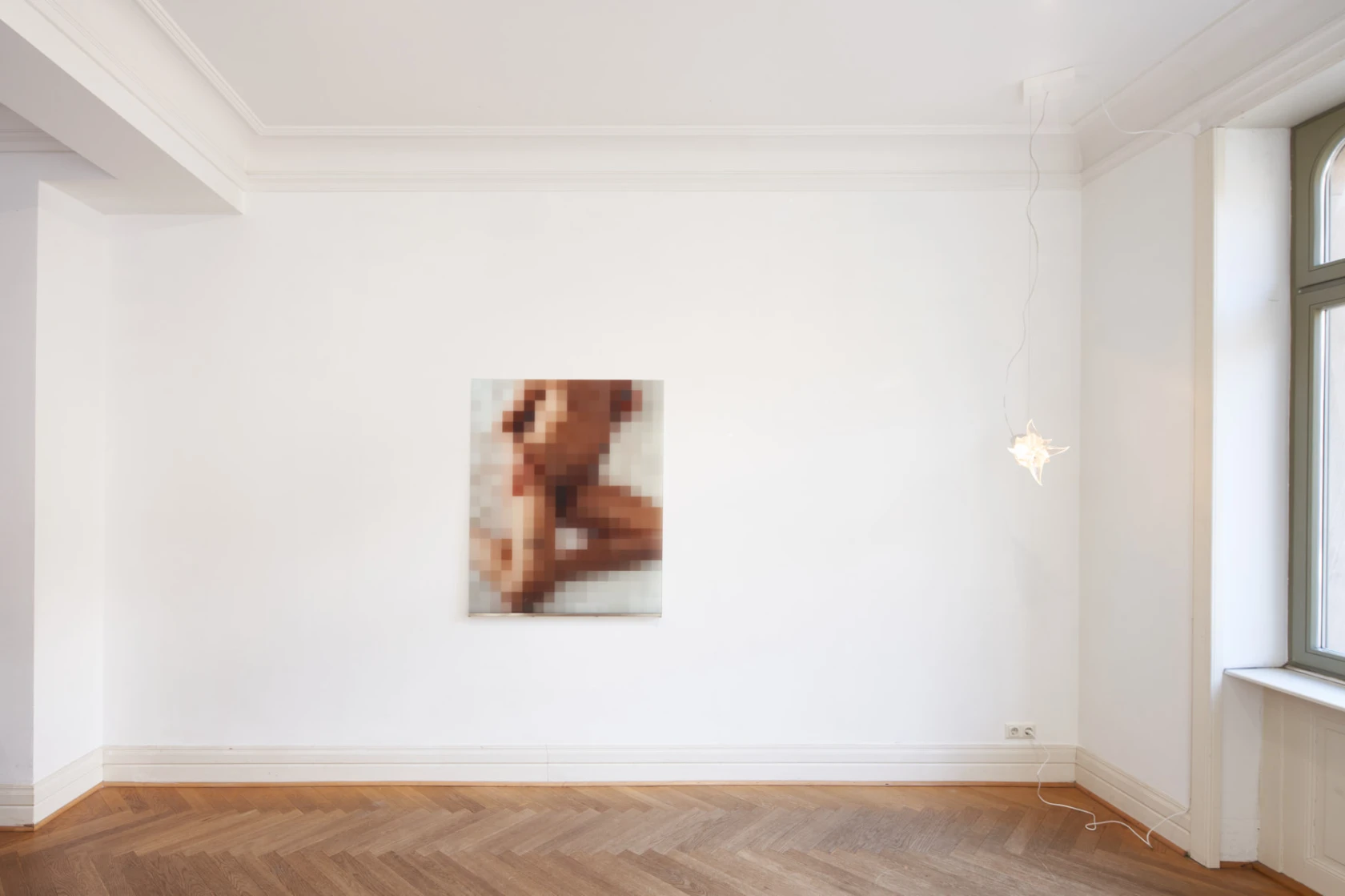
Questions of closeness and distance, and how both relate to feeling at home, surface throughout the rooms. In one photographic work, an image dissolves into pixels in shades of nude. Only when viewed from across the apartment does its actual motif reveal itself. Intimacy, quite literally, requires distance to become visible.
The work “M.” (ceramic ink print on glass) depicts a pixelated body whose gender and identity remain ambiguous, using the digital glitch to disrupt expectations of how bodies should be read and categorised.
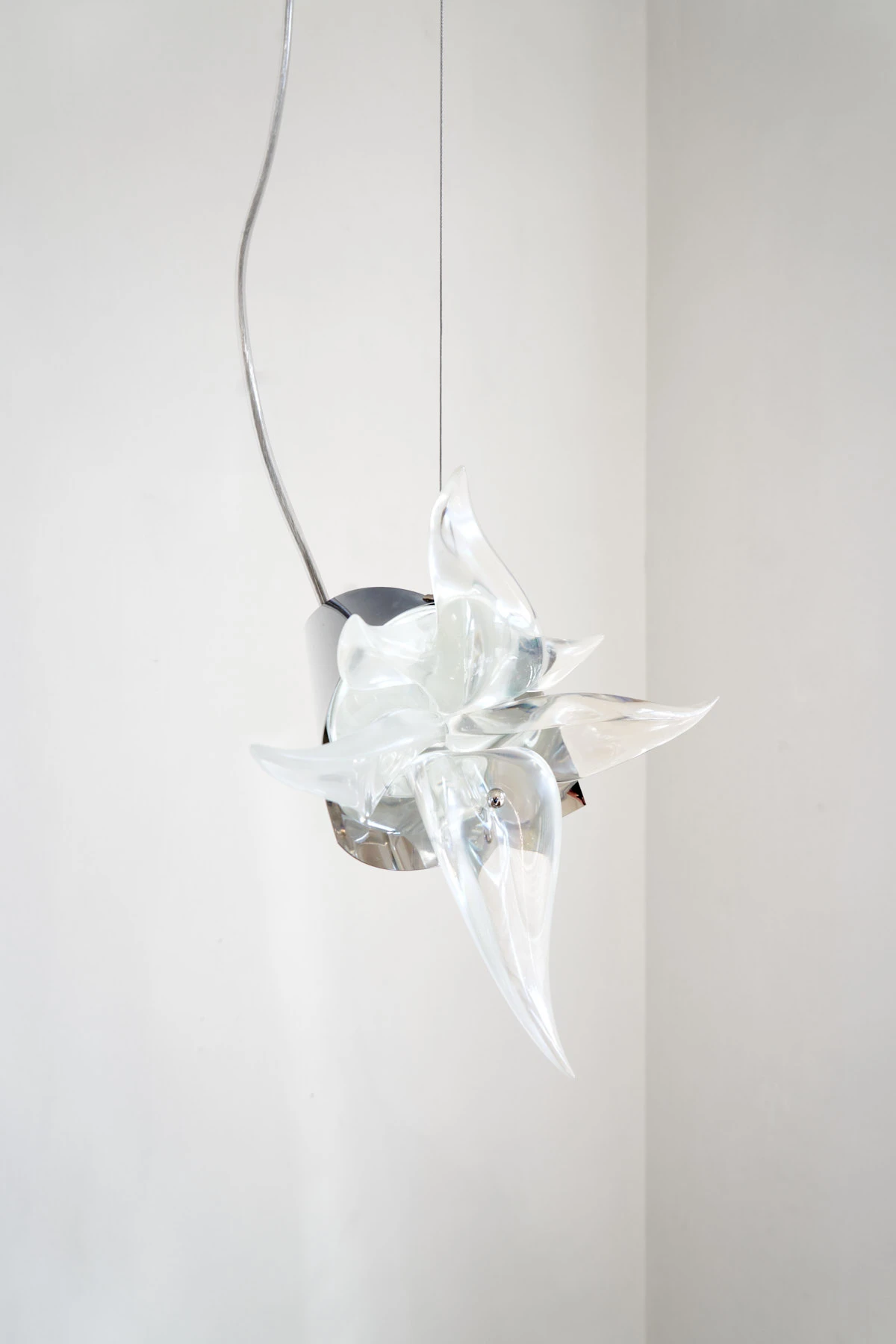
“Bouquet”, made from resin, stainless steel, titanium and LED, reinterprets the lily’s historical associations with queer identity and coded affinity as a luminous, suspended floral form.
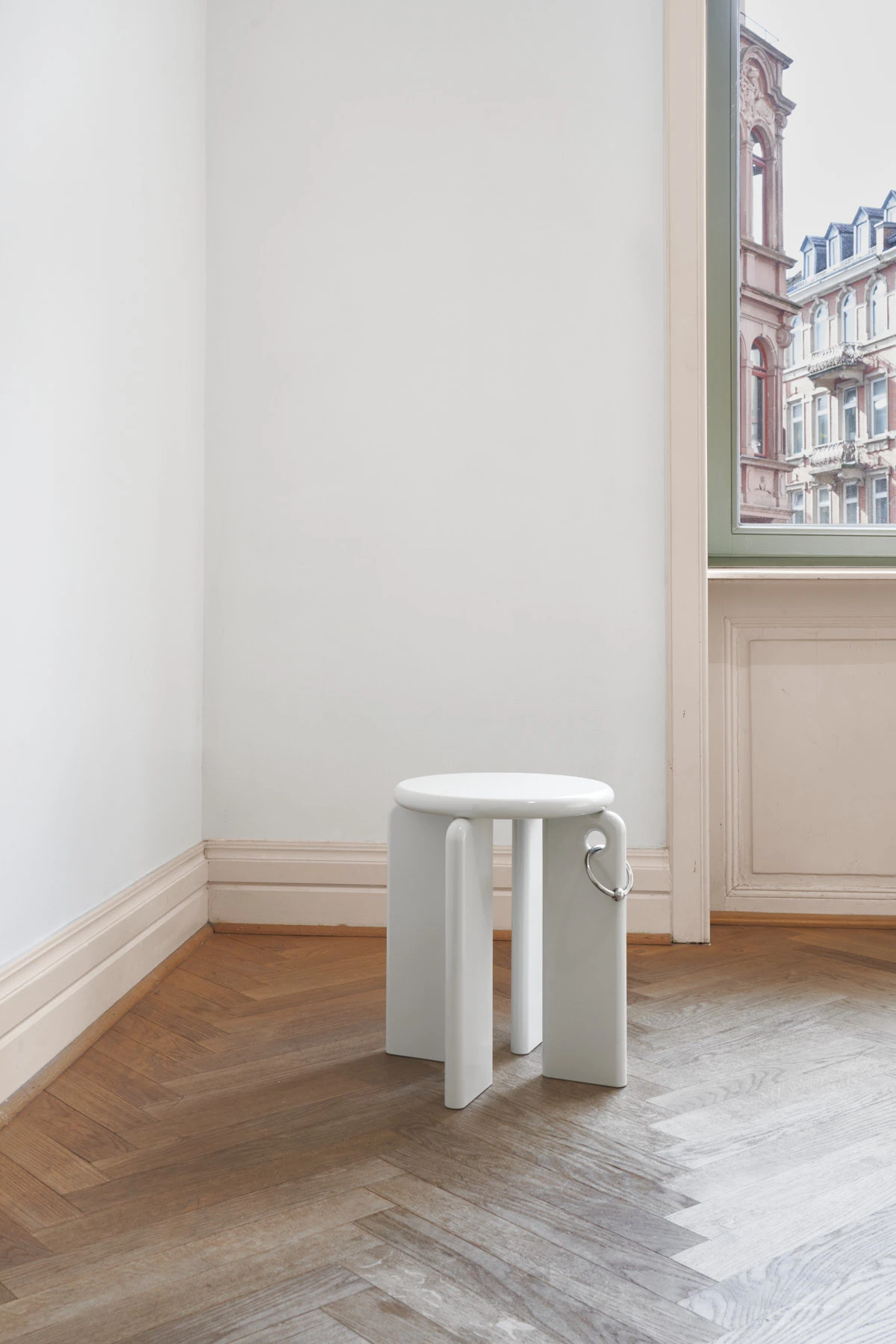
“Pierced Stool”, made from lacquered MDF and stainless steel, references body piercing and adornment, bringing queer self-expression and desire into an object that plays with the tension between function and ornament.
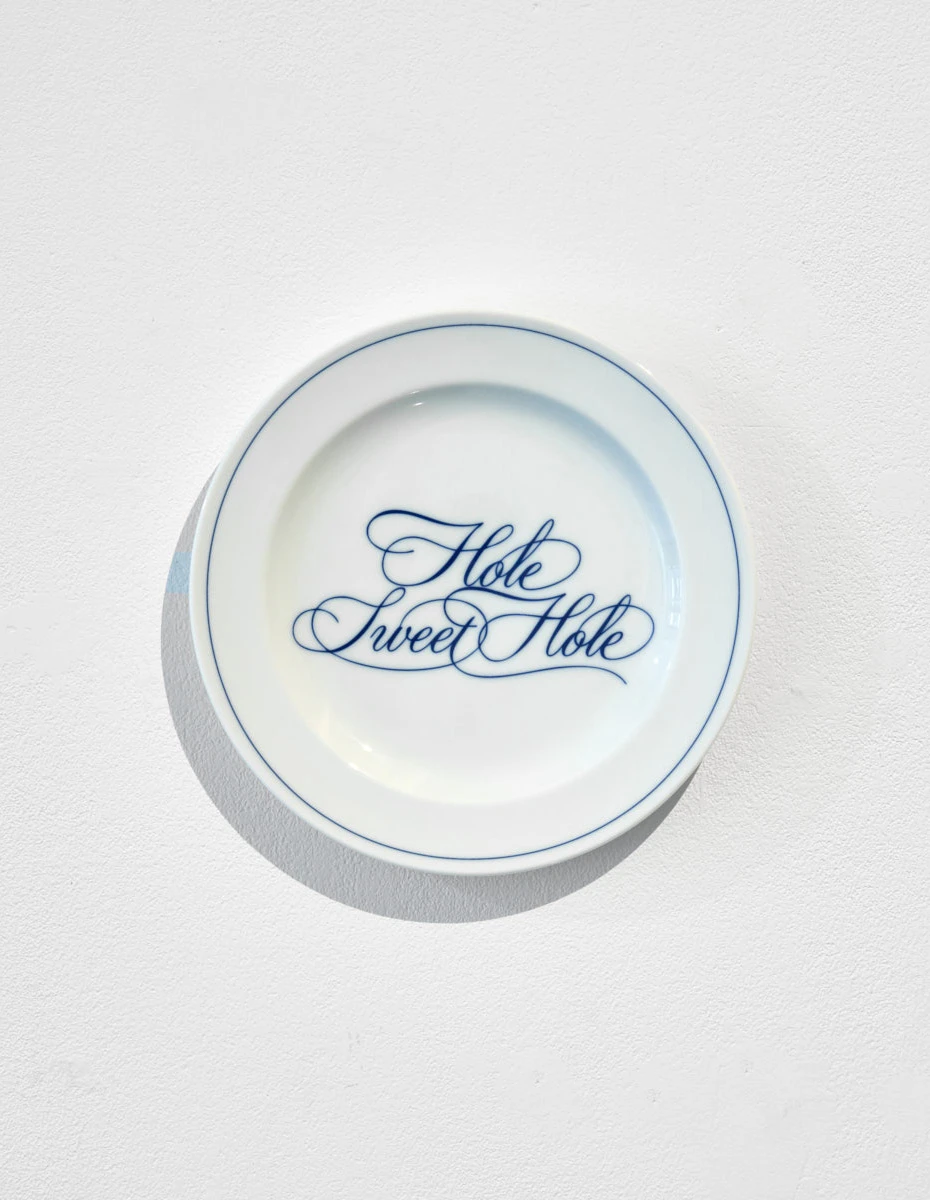
The series “Tasteless Plates” brings queer language and sexual desire onto classical porcelain, using the material’s history as a marker of cultural distinction to challenge ideas of taste.
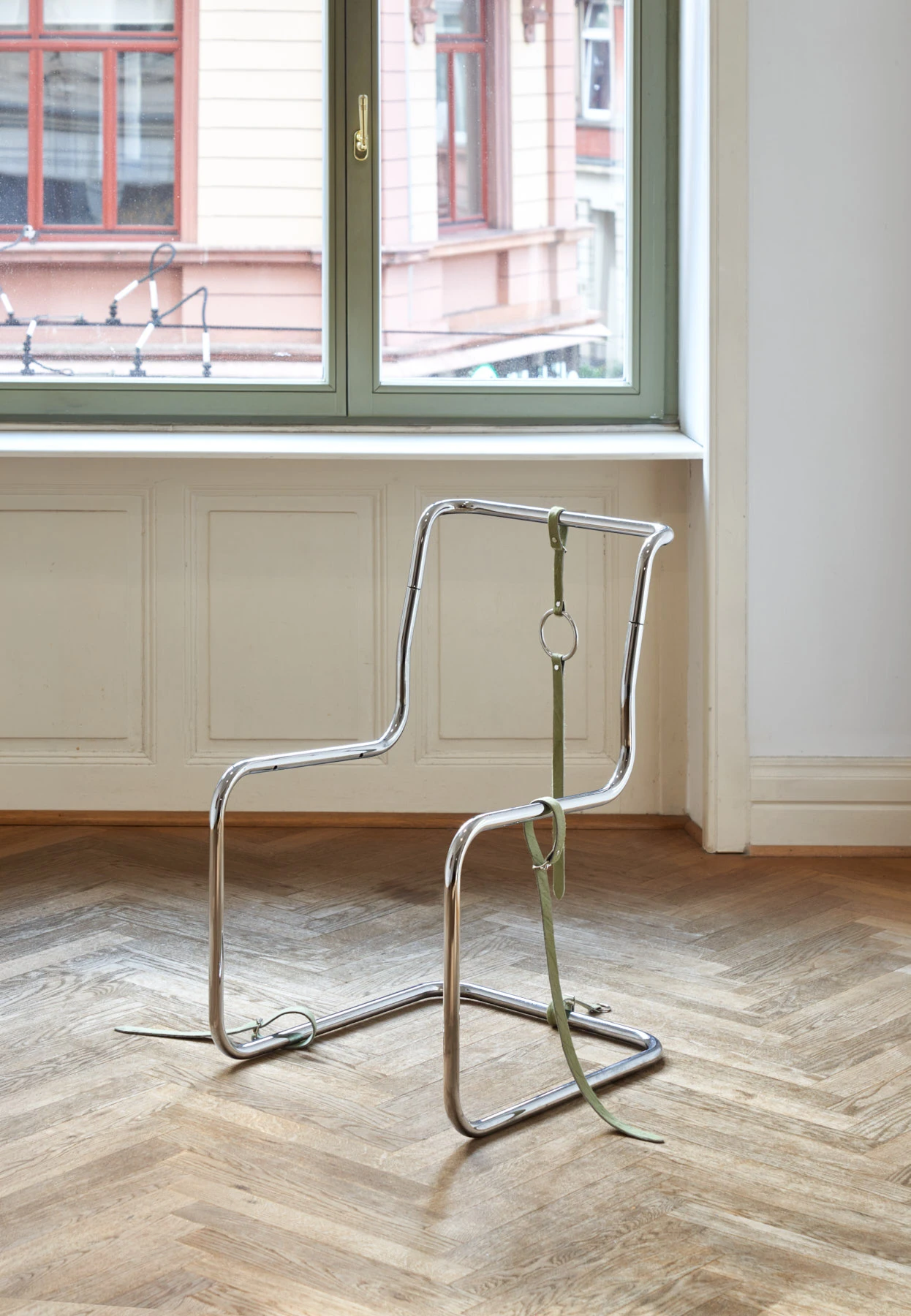
Desire is another recurring aspect of the exhibition, and of Jahner’s work more broadly and appears without shame or disguise. Where do we feel safe enough to express arousal and fantasy, even kinks? A Thonet cantilever chair, stripped of its seat and backrest, has been reduced to its cold chrome frame. Here and there, Jahner has added leather elements reminiscent of fetish gear, turning a familiar piece of furniture into something that oscillates between restraint and physical attachment to the object.
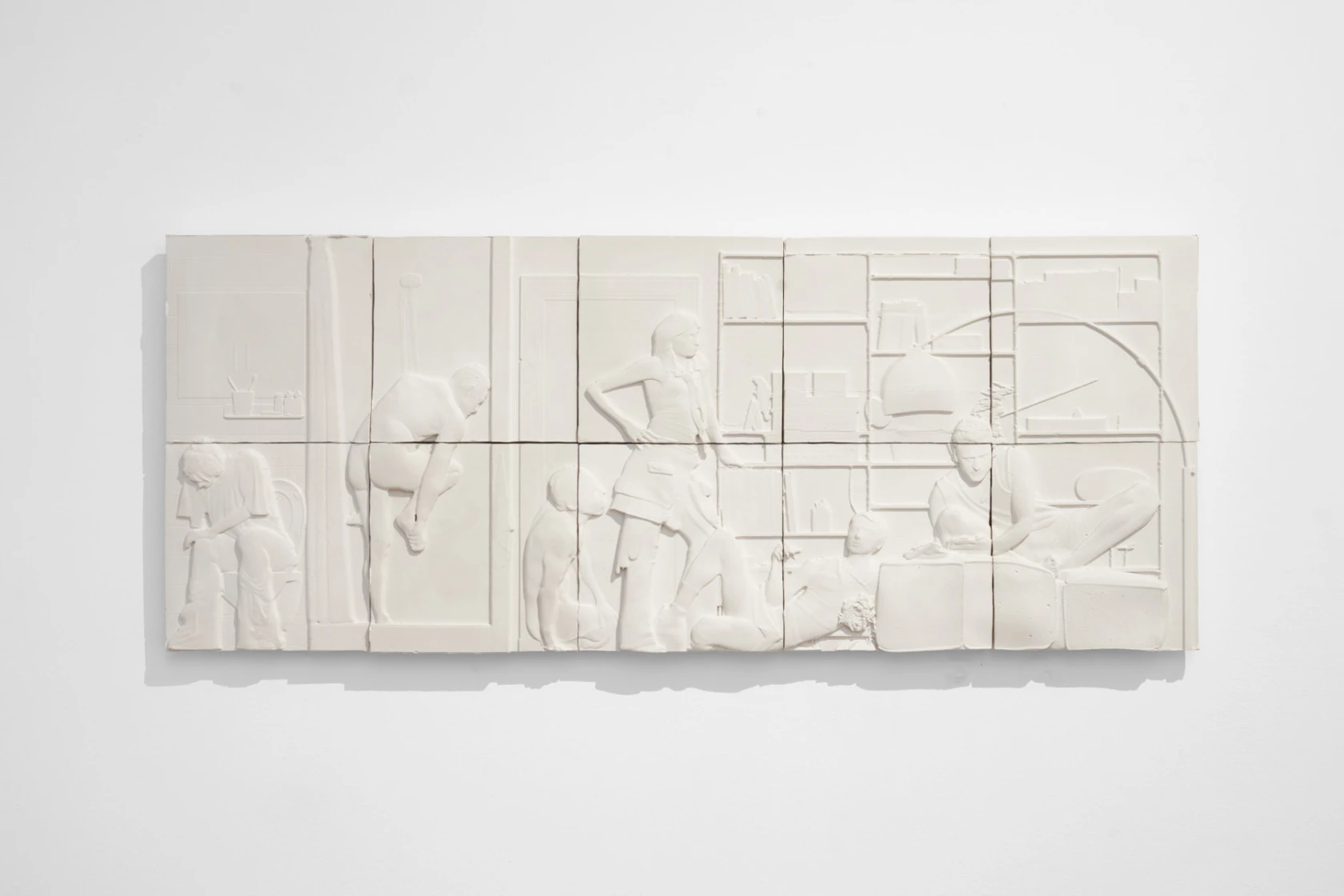
But home, Jahner suggests, is also made through other people: through friendships, lovers and relationships accumulated over time. In a plaster frieze assembled from real photographs, bodies come together in scenes that resemble an open living room, or perhaps a communal gathering space. Here, home becomes less an architecture than a social structure, something created between people.
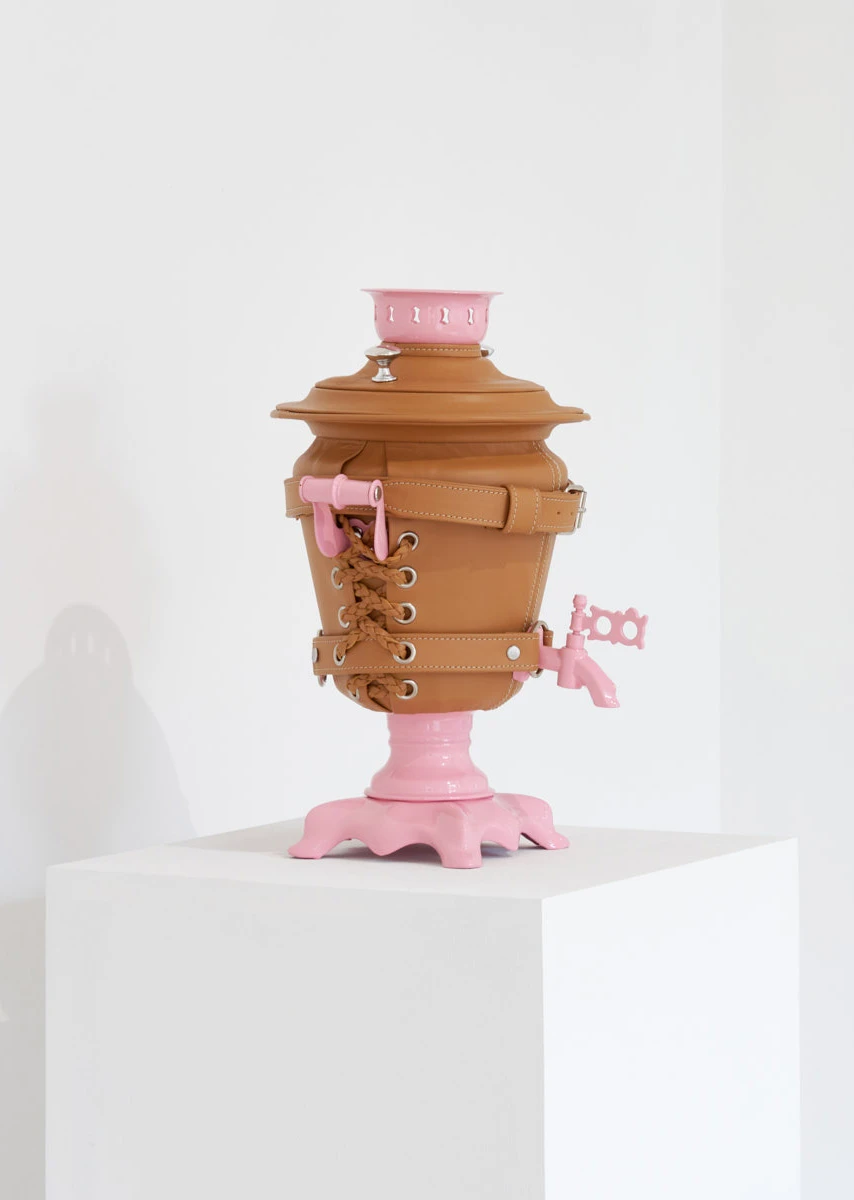
“Samowar 1988” (leather and 3D print) reworks a family heirloom brought to Germany by Jahner’s grandmother, queering the familiar object through bodily and sexual references and questioning ideas of origin and belonging.
“Freischwinger” (Thonet S 33 steel tube and leather) strips the modernist design icon of its seat, replacing it with leather straps that reference restraint and question how design shapes and controls the body.
“Still Life” (plaster and wood) translates photographs from Jahner’s circle of friends into relief, layering moments in time to explore queer identity through different perceptions of temporality.
The works in “Coming Home” could hardly be more different from one another, yet they remain connected through a restrained material and visual vocabulary. Metal reappears, as do leather surfaces, transparencies, muted pink and beige tones and forms that hover somewhere between the bodily and the functional. In the work “Bouquet”, a lighting object resembling an open lily—or perhaps a vulva—becomes an homage to another understanding of objects and art, one preceding the clear divisions introduced by industrial production.
It is a fitting motif for a product designer making his way into the realm of art. Jahner does not abandon the object, nor his understanding of how bodies relate to it. Instead, he seems to free it from the obligation to solve a problem or fulfil a clearly defined function. In “Coming Home,” objects carry memories, desires, relationships and contradictions. They can make us feel close or keep us at a distance, symbolize privilege or pure vulnerability.
For Gregor Jahner, then, the exhibition is not just a coming home, but a genuine homecoming.
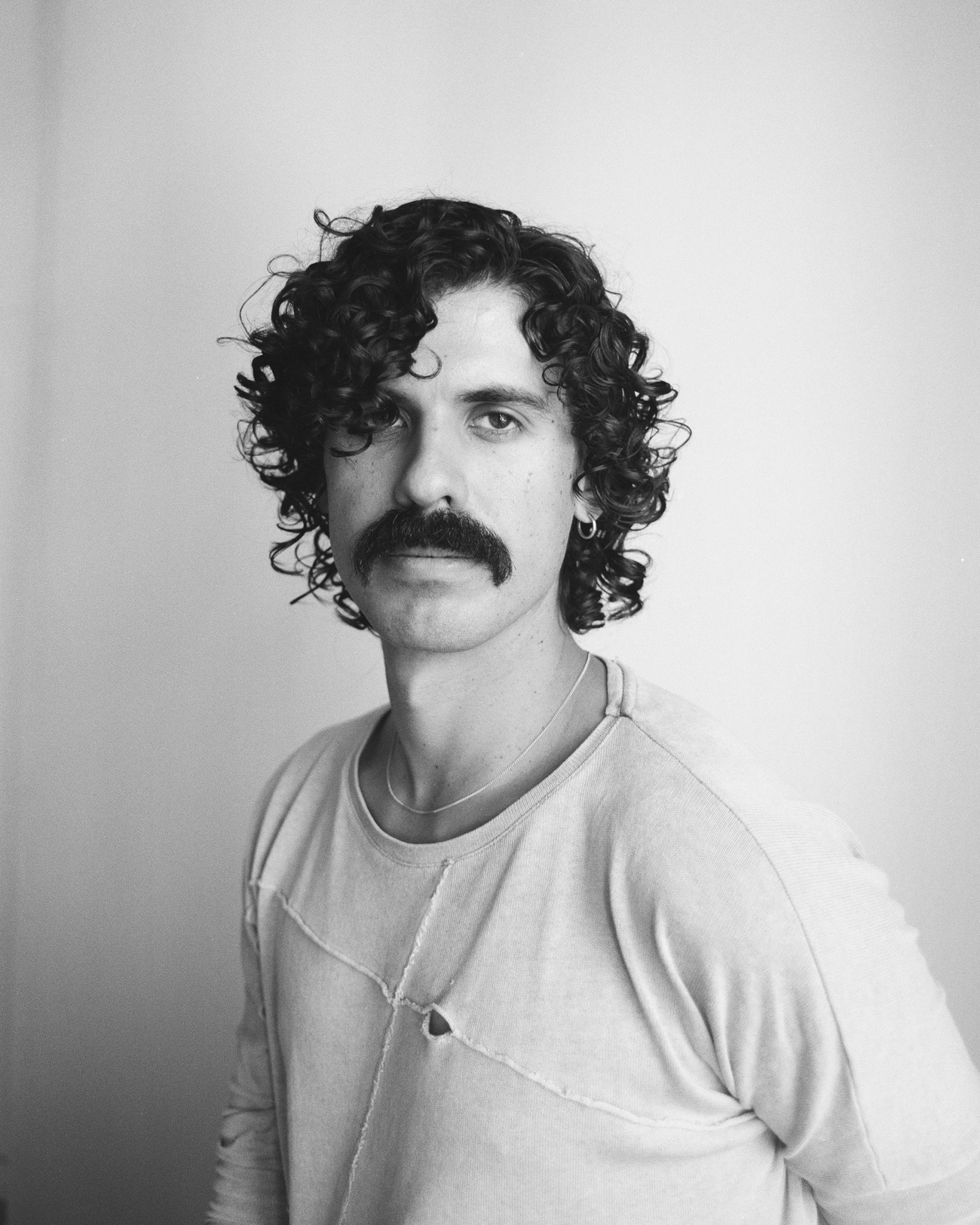
Gregor Jahner is a Berlin-based designer and artist whose work explores queerness in design, questioning social norms and structures of power through themes of intimacy and the body. Photo: András Tibor Vizi
“Coming Home” is on view at Gallery Jean-Claude Maier in Frankfurt from September 18–November 15, 2026, and can be visited upon request through the gallery. It is part of the official programme of World Design Capital 2026.
Join our community to post comments.
Login
Create account
Recent Comments