Artificial intelligence is often discussed in extremes: as existential threat or inevitable next stage of technological progress. Serena Dokuaa is not interested in any of those simplifications. For the poet and AI policy expert, currently leading state policy efforts at the US-based and independent Data & Society Research Institute, the real question is not whether machines will one day outsmart humanity, but rather who is building and controlling today’s systems.
With a background in history and genocide studies, Dokuaa came to AI through a deeper concern with the role technologies play in organising power. In policy, she has worked at both state and federal level in the US, pushed for stronger protections during the Biden administration and was involved in the early work of the US AI SafetyInstitute Consortium. Yet Dokuaa’s work does not end with policy. Alongside her research, she writes poetry shaped by Black feminist thought, central also to the way she thinks about AI regulation. In the following conversation, Dokuaa speaks about AI not as a neutral tool, but as a field in which bias, power, labour, race, regulation and imagination collide. What emerges is not a familiar warning about rogue machines, but something more grounded and perhaps more unsettling: a critique of the structures already governing the present anda testimony to the conditions of our time.
the thing Magazine:
Serena Dokuaa, should humanity be afraid of AI?
Serena Dokuaa: I think we should be afraid, but not in the way people often imagine. The common framing is very speculative — fear of autonomous systems or machines taking over. I don’t think that’s the most relevant concern. What we should be wary of are the political and economic structures that shape AI development.
the thing Magazine:
Could you expand on that?
SD: These systems are largely owned by tech companies, and their development is closely tied to government interests, particularly around surveillance, militarisation and national dominance. The real issue is not AI as an independent entity, but how it is being used within existing power structures. I would describe it as the difference between theoretical and applied philosophy. When you look at the actual conditions under which these systems are developed, there is reason to be concerned. There’s also another dimension: the flattening of humanity. AI systems rely on data, and in doing so, they require forms of knowledge to be translated into data. That process inevitably excludes certain ways of knowing. Dr. Melinda Sebastian uses the term “epistemicide” to describe the erasure of knowledge systems. I think that is something we should be concerned about, particularly for people who are already marginalised. For me, the fear is less about the technology itself and more about what it does to ways of being and knowing.
the thing Magazine:
Mistrust in science and research has become increasingly visible across many liberal societies. How does this shape your work, and do you see a link between that growing scepticism and the rise of a technology as powerful as AI?
SD: I think it is important to be specific about what we mean when we talk about mistrust in science. Science is, of course, valuable, but it is also marked by histories of racism, sexism, colonialism and harm. When we talk about mistrust, we have to ask: for which groups, and based on what history? At Data & Society, we think a great deal about people’s lived experience on the ground. Our work is very empirically grounded, often using qualitative and ethnographic methods to understand the social and cultural impacts of AI. That orientation is important to me.
“The real issue is not AI as an independent entity, but how it is being used within existing power structures.”
the thing Magazine:
Why is that?
SD: Something I’ve noticed in AI discourse, and part of why I turn to poetry, is that when you want to speak about harms to marginalised communities, you are immediately expected to produce extensive proof. You need citations, documentation, evidence — of which there is a lot. But when people talk about the benefits of AI, they often do so without any of that. It is frequently pure conjecture. I am interested in what that tells us about the Western relationship to proof and science. Who is expected to prove themselves, and who is simply allowed to assert? To me, that question is deeply connected to scientific integrity. I think that opposing racism, sexism and other forms of discrimination is essential to the integrity of science. When research becomes driven primarily by profit motives, or by a narrow conception of science rooted only in STEM [Science, Technology, Engineering, and Mathematics], it drifts away from that integrity. I see the proliferation of AI systems that reinforce racism and other forms of oppression not only as a threat to marginalised communities, although it certainly is that, but also as a threat to science itself and to research that genuinely works in the public interest.
the thing Magazine:
What about the connection between rising scepticism and AI?
SD: I do think it is striking that they are occurring at the same time. People are being asked to accept a technology that is being integrated into every part of life, often without their consent, while there has also been extensive reporting for years on bias, inaccuracy and harm. In that sense, AI has given people many reasons to be sceptical. To me, that points to the extent to which capitalist and nationalist interests have come into conflict with scientific integrity and with research that is meant to serve the public.
“AI has given people many reasons to be sceptical. To me, that points to the extent to which capitalist and nationalist interests have come into conflict with scientific integrity.”
the thing Magazine:
Bias is a central concern in AI and in your work. It refers to the way existing inequalities become embedded in training data and are reproduced by these systems. Do you think a truly unbiased AI is possible in the future?
SD: No, I don’t think so. In an ideal scenario, we might have systems that do not actively reproduce discrimination, but I would not call that unbiased. AI systems are built on data, and data is never neutral. Some groups are always more represented than others. Certain languages dominate. Certain ways of knowing are privileged. Even beyond questions of bias, there is a deeper issue: AI systems are shaped by particular epistemologies — by Western ways of defining knowledge. That means other forms of knowledge, such as Indigenous knowledge systems, are in tension with them. We should also ask whether it is desirable for all forms of knowledge to be translated into data in the first place. There may be contexts where communities develop their own AI systems for their own purposes. That could be valuable. But that is very different from integrating all forms of knowledge into large, centralised systems. So, in that sense, I would say no — a truly unbiased AI is not possible.
the thing Magazine:
If those in power benefit from biased AI systems because those systems help maintain their power, what mechanisms can realistically hold them accountable?
SD: When it comes to the question of accountability, political will, public pressure and a strong civil society response become crucial. There are people who benefit not only from these systems, but from the absence of accountability altogether. There are also very explicit right-wing interests invested in AI, and in the fact that right-wing content often performs well within these systems. I cannot say there is an easy answer to how we hold those in power accountable. It takes people power, longterm advocacy and finding political partners who are willing to push. Will it be easy? No. Will it happen quickly? Maybe not.
the thing Magazine:
What about the role of profit? Do you think truly responsible AI is possible within capitalist, profit-driven systems?
SD: In some ways, those logics are fundamentally in tension with each other. You could argue that there are forms of “responsible AI” in the sense that companies try to mitigate the most visible harms. But if we take a deeper perspective, if we ask whether Black women are protected, whether surveillance is reduced, whether systems are not reinforcing existing forms of oppression, then it becomes much more difficult. Considering how AI is tied to surveillance infrastructures, militarisation, or geopolitical conflicts, it becomes clear that profit-driven systems place strong limits on what is possible. There are certain areas in the US, national security, for instance, where ethical considerations simply stop being prioritised. From a Black feminist perspective, we also have to think transnationally. The way people are treated across borders is not separate from our own conditions, it is directly connected. So, when we consider those global dynamics, I would say that a truly just AI ecosystem is probably not achievable within profit-driven capitalist systems.
“[…] a truly just AI ecosystem is probably not achievable within profit-driven capitalist systems.”
the thing Magazine:
Could you elaborate on how Black feminism shapes your thinking on AI?
SD: For me, Black feminism is crucial because it emerges from the lived experience of Black women, we exist at the intersection of multiple forms of oppression — race, gender, class and others. That positionality allows for a very particular way of seeing the world. Black feminist thought is deeply grounded in reality. It asks: what are people actually experiencing? What are the material conditions of their lives? It does not operate on an abstract, idealised level in the same way that dominant frameworks often do. That is important because many dominant perspectives — particularly those shaped by white, male, Western positions of power — can afford to remain abstract. They can propose visions without grounding them in lived experience, without having to prove their claims, without being accountable to those most affected. Black feminism does the opposite. It insists on accountability. It insists on grounding theory in lived reality. There is also a strong emphasis on inclusivity and solidarity. In Black feminist thought, Black women’s liberation necessitates the liberation of all oppressed peoples. There is an understanding that liberation cannot be partial.
the thing Magazine:
How does that translate into concrete practices?
SD: That’s where I find Janelle Jones’ “Black Women’s Best” framework particularly compelling. She looks at economic policy and asks: if we design policies that actually work for Black women, who are often most marginalised, then those policies will work better for everyone. It’s a way of making policy more precise, more grounded and more equitable. Applied to AI, that means asking: is this system beneficial to Black women? If it is, I would be much more inclined to believe it is broadly beneficial. If it is not, then we have to question its value. It also means actively ensuring that different communities are involved in shaping these systems. It requires you to think beyond your own positionality. I think that way of thinking is largely absent from dominant approaches to AI.
“Is this system beneficial to Black women? If it is, I would be much more inclined to believe it is broadly beneficial. If it is not, then we have to question its value.”
the thing Magazine:
Finally, what gives you hope right now?
SD: What gives me hope is seeing people organise, and seeing people refuse to engage with technology on terms that are imposed on them. I find hope in people reclaiming agency, deciding how and whether they want to engage with these systems. For me personally, art is a major source of hope. In my own work, I draw on Dr. Christina Sharpe’s theory of “the wake”, which describes how we continue to live in the ongoing aftermath of slavery. For me, engaging with history, with ancestry, with the lived experiences of Black people, rather than being pulled into a constant, future-oriented, capitalist logic, is a form of resistance. There is a strong pressure to disconnect from history, from truth, from ourselves. Any practice, whether artistic, political, or social, that resists that and reconnects us to those histories brings me hope.
Further Notes
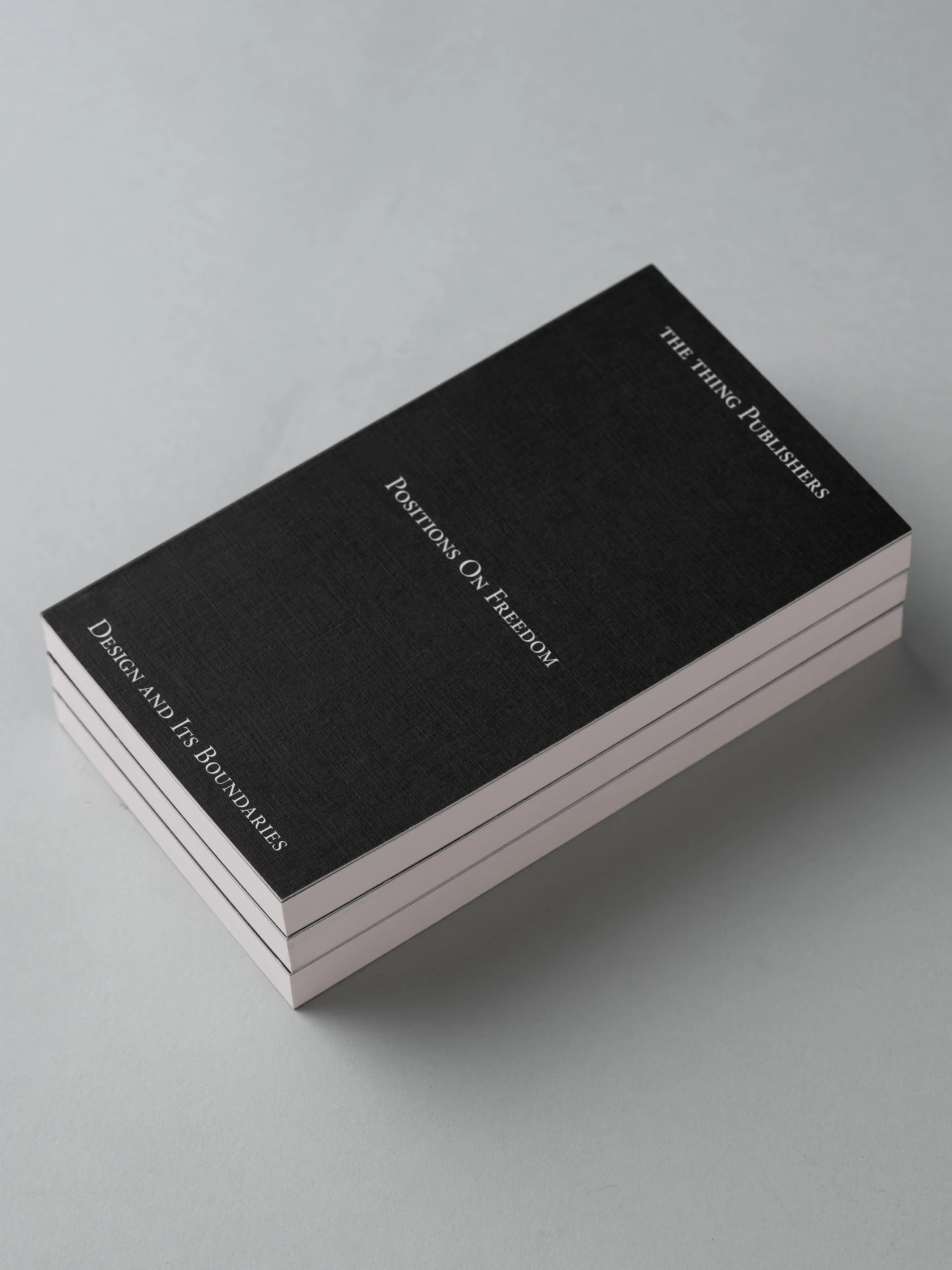
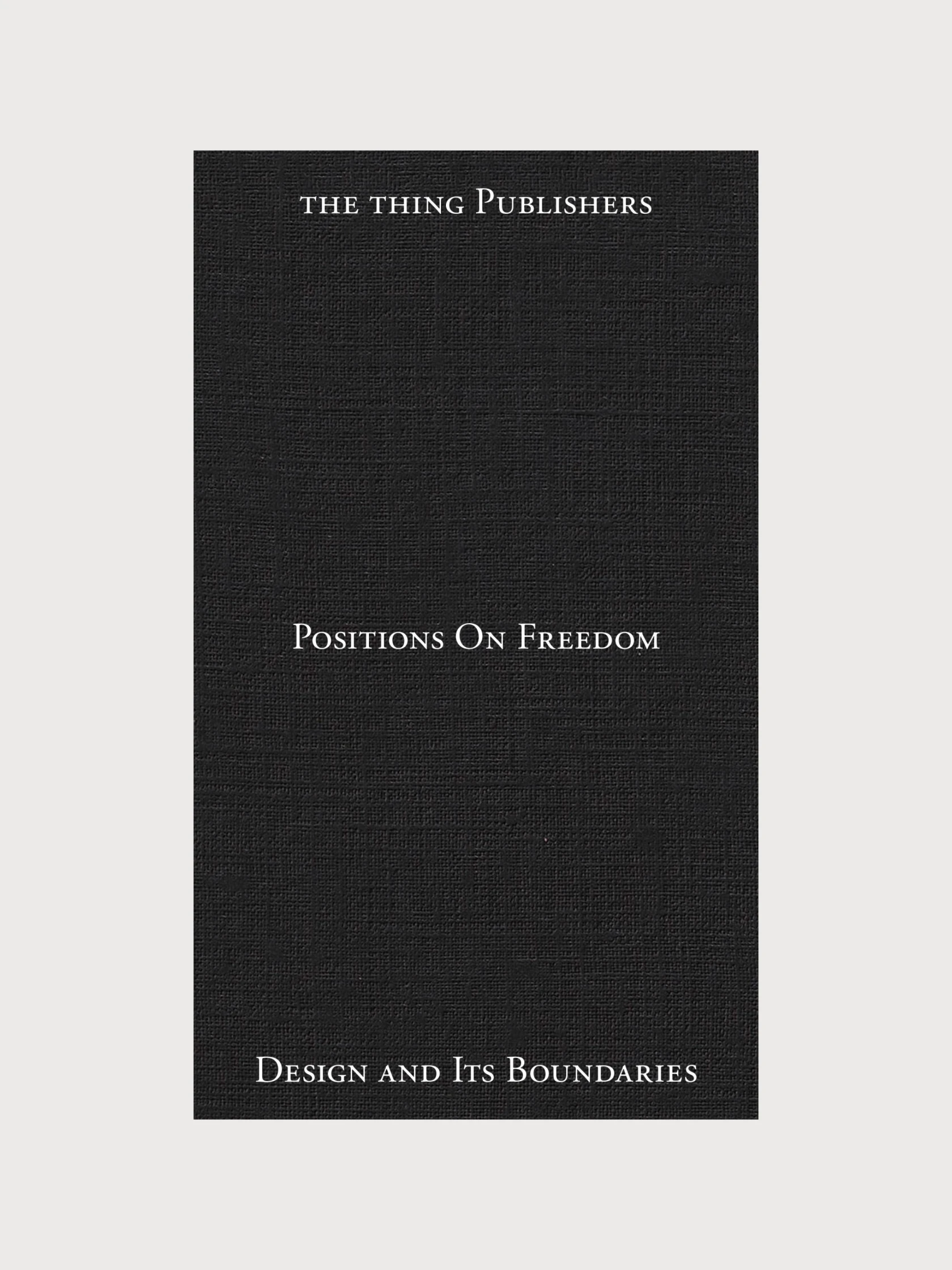
This interview is a shortened version of a text first published in the reader “Positions on Freedom. Design and Its Boundaries” in May 2026. If you want to support independent publishing on topics like this, feel free to purchase the book here.



Join our community to post comments.
Login
Create account
Recent Comments
No comments yet.