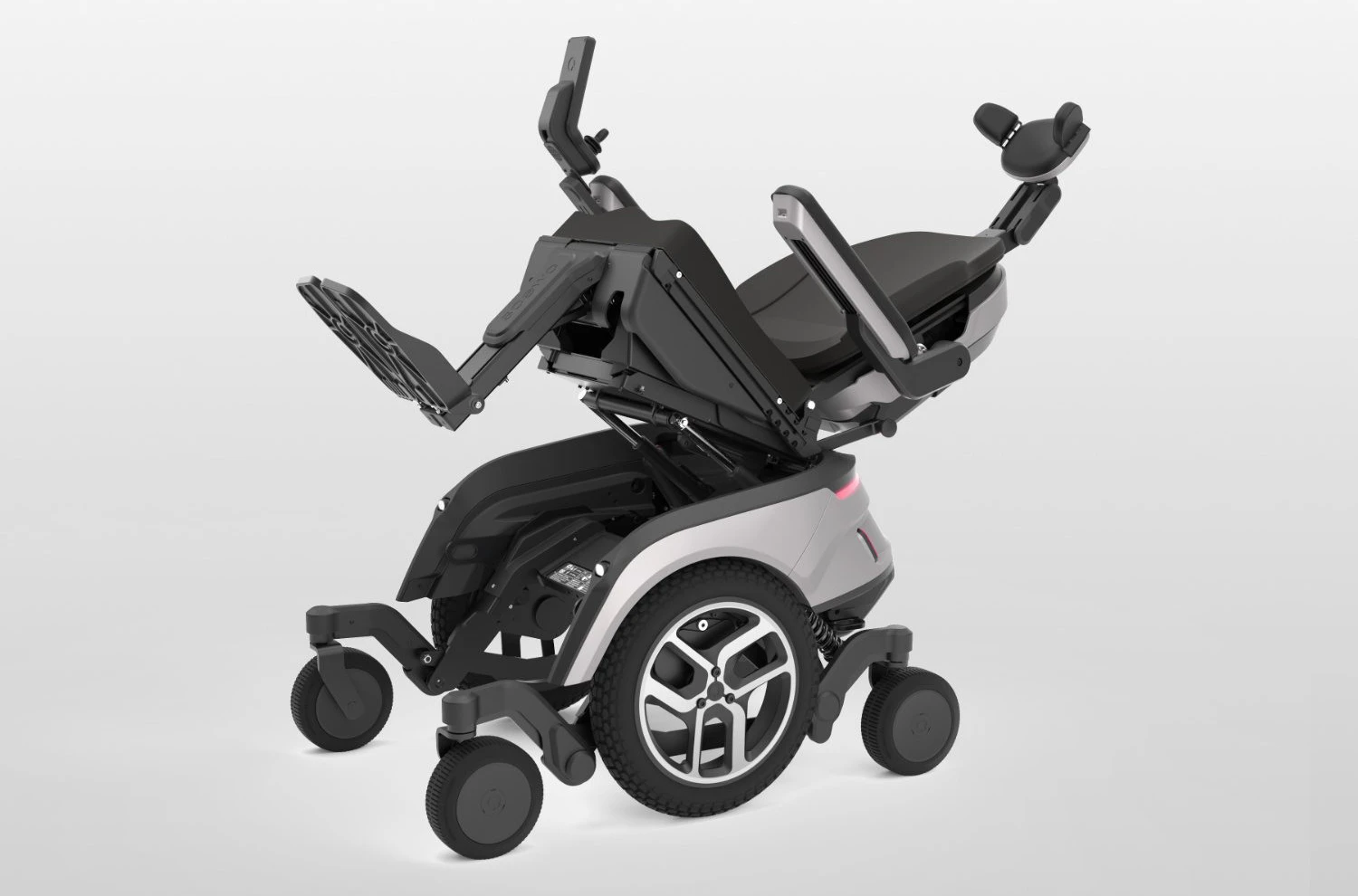
This is a rough draft, fragmented, unpolished. It’s “TIP”: Thought In Progress. I couldn’t finish it in time and it might not be finished in months or years. I decided to expose that quality as a (very) little act of anti-ableist resistance — and as an invitation to join this thought in progress, this construction site.
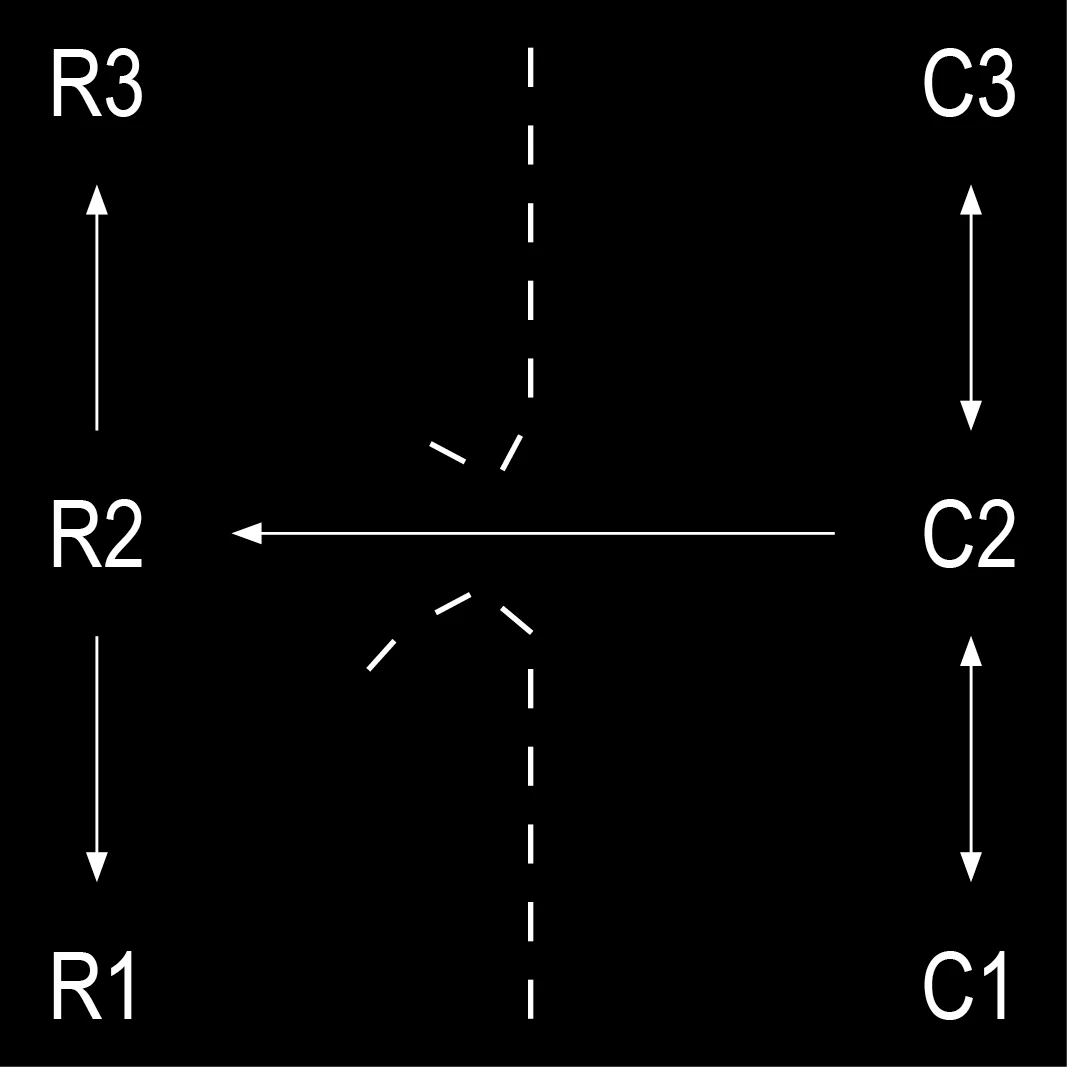
The diagram shows a model conceived by Djamal Elangui Okoko, mapping different levels of transformation between capitalist critique (C) and revolutionised alternatives (R). The three levels move from product (1) to practice (2) to system (3) and form the basis for the ideas and structure of this text.
C1: The Ableist Design Product
“When I grow up, I want to be a product designer. I will create things that are useful and beautiful. I will create things that enrich lives and this society. I want to make this world a better place through my design.” When I was in the preparatory class for the entrance exam [Eignungsprüfung] for design studies, our Professor told me something like: “Of course, this is your topic!” Disability.
This statement bugged me. She said it with such certainty. I’m disabled, a wheelchair user, of course this will define my practice — according to her. But it also bugged me, because I knew that she was right. What I didn’t know was that I’ll end up writing a critique of ableism in design, drawing from Marxist theory, about a decade later. How the fuck did that happen As part of the entrance exam, we were asked to design an inclusive product. I thought about some lived experience that I could base my project on. The scenario was a person that needed assistance to turn over in bed, like me. In this scenario, however, there are really two people: a disabled person needing help but experiencing guilt for calling the care-giver and said care-giver, experiencing fragmented sleep but wanting to be on hand. More “independence” in case of the disabled person, and “relief ” for the care giver — both framings can and should be reflected on critically. My solution was quite a technical one: a mattress with many individual surface elements that can move up and down to support a person’s turning or adjusting movements. This was combined with an electrically movable bed sheet system that adds horizontal pulling (left-right) to the vertical pushes. The goal was to apply force in three dimensions to assist the body’s movement. Conceptually, this system would be able to detect the body’s position and pressure on the mattress. A tactile-visual interface is added with two functions: (1) to represent this data — as a pixelated top view of a person in bed — and (2) to control the movement by commanding the push-and-pull motors.
This project sketch granted me access to higher education. But already while working on this concept, first doubts occurred: What did they actually mean by “inclusive”? The two-sentence homework task didn’t sufficiently clarify. Are we simply designing something related to disability? What differentiates “inclusive design” from simply being assistive technology — isn’t my mattress the latter? Or does “inclusive” mean “for all”? Or, if it means “to be usable by as many people as possible”, how many physical, sensory, cognitive and other conditions must be included for something to be considered “inclusive” enough? The controlling interface was certainly not usable by many people, since it required certain abilities to operate. There also might’ve been some body shapes not taken into account in the motor controlling software. In short: my project could be labeled ableist. But there is an additional layer to the question of a product being ableist, namely its entanglement with the surroundings it exists in. As mentioned, I initially created this design with my own experience in mind, which was care work at home, done exclusively by my parents, in a family setting and private apartment. In this social and architectural context, this design was supposed to have had a certain purpose. That was, for example, shaped by my parents’ need to leave the house and fulfill expectations at their wage work.
Without this, the idea of a “relief” might not have existed or would’ve been substantially smaller. The same applies for the absence, or adaptation of, systemic support after my parents broke up and moved apart. From then on my mother did the turning at night (besides other care work) most of the week. The truth is, my dad supporting me during the day could not compensate for her getting up several times a night and having to leave home for work early. Her being able to work much less without compromising her/our standard of life would’ve helped, but it wasn’t possible. Another dimension is architecture. We lived in a pretty apartment, but we didn’t have many rooms, so I shared mine with my sibling until I moved out during my studies. There are multiple implications: mainly, that there was no space to accommodate a professional assistant. In that case, we could’ve kept the family situation while the care work was split and my mom would not have been as tired during the day. This also leads to larger-scale questions of how we understand living, housing and family — which foreshadowed the scope of the social dimension in every “design project”.
Now imagine what happens if we put this mattress in the context of residential “care”. Here in Germany, almost half of the care organisations are privately owned, and the number is growing. But even for the other kinds (non-profit or state-run) it is the case that they will try to reduce the amount of labour costs where possible. As it stands, institutions are under-staffed, over-worked and under-paid, sometimes lacking in adequate infrastructure and training, which could lead to a poor quality of care ranging from negligent to violent… An object like my mattress could make people in these institutions suffer longer, because the advantage of these technological innovations will often be used to justify budget cuts in staff and maintenance — even though it will be financed by some one-time state or private subsidy. And all this, whilst the organisation would propagate its “cutting-edge facilities”. This leads to two further aspects: the product has to be acquired (granted or bought) to be usable. No money or grant, means no usage. As disabled people statistically have less money and insurances have lump sums for product categories, innovative technology mostly doesn’t make it to the people who need it. So why am I designing something that isn’t accessible to 99% of the people needing it — ain’t that ableist?
These remarks are meant to show that it’s not possible to assess the inclusiveness (whatever meaning is applied) of a product without considering the context it’s situated in, which is society at large. And two things are as crucial as they are mostly hidden: society is fundamentally shaped by capitalism, and capitalism is inherently ableist.
A design product is brought to existence through a certain design practice. The product is a result and dependent on the economic system — be it in the context of manufactory, large corporations, agency or self-employment. In the end, the question is always if the invested resources will (or could) pay out, if more money can be made than spent on time (e.g. research and development and production), tools (software, machinery, consulting etc,) and materials. The design practice is always tied to (a) the competition between companies and (b) the competition among workers for jobs for enough income — or as much as possible — to survive and live on. What we design and the process of designing always depends on how much money and time is economical and calculated.
///
An “inclusive” product does nothing to design being ableist. A new “inclusive product” is still entrenched in ableism.
A designer who’s class conscious (of being working class) and tries to act accordingly does more against ableism than one who’s designing another “inclusive product”, doomed to disappear as a forgotten concept, or released into the market and it’s “logics” as a commodity and to be so unequally distributed/available/accessible to (disabled) people, that no one could seriously talk about an “inclusive product”. A truly “inclusive product” would be no commodity, because its primary function is to be a tool in the rivalry between capitalists and the accumulation of capital. A truly “inclusive product” would be an object that’s available to whoever needs it, regardless of present day limitations like location (particularly in global, colonial relations), money/income/wealth, citizenship (e.g. insurance), sexism and racism (e.g. in medicine, gender and racial bias), transphobia etc.
C2: The Ableist Design Practice
However, there was a point when I wanted to actually pursue this project to see how far it can get. Back then, I was already aware of some of these concerns, and also presented them in the university entry exam. But I was also highly motivated and proud of this project, being accepted for studies in product design, one of my long awaited dreams, a new chapter in my life. Why not start with a bang and bring this mattress to the market, or at least find some big partner to continue the research?! It wasn’t long, though, until I came to realise a couple of things: mainly, that this would be tons and tons of work, and time — unpaid, of course. The first thing I was looking into was the possibility of applying for a patent, so that in the future I could get some money from my invention. Real expertise, and help, were needed, that became clear quickly. So I asked around and luckily, I was connected with a mechanical engineer turned tango teacher.
Consulting him revealed that a patent (1) needs quite some technical depth because it (2) has to distinguish itself from other patents in great detail, which would’ve meant rigorous study of those. Again, this would’ve meant a great investment in time and money, while my capacities were limited. As a disabled person, I have much less thereof compared to a similar, non-disabled person: much more time consumed by everyday tasks like getting up or into bed, showering and everything bathroom-related, added by regular things like physiotherapy, various doctor’s appointments and mentally exhausting state applications for things like personal assistance to go to university. Personal assistance to pursue the research and networking needed for this project (especially for mobility to leave the house) is something the local authorities would’ve never granted. I just started studying and was probably more tempted to the light fun of university projects, but also the cultural and disability advocacy work I did back then. As such, my mattress was dropped and disappeared into conceptual doom and was never again moved an atom closer to realisation.
Retrospectively, I want to go deeper and ask:
What (capitalist-ableist) relations, constraints and dynamics led to me dropping this project?
technological research would’ve been necessary, only big companies with a big research budget could’ve invested and brought this product to the market — which they only do, if they expect it to be profitable or otherwise helpful to their growth (of capital); scale
affordability, scalability, insurance (e.g. citizenship, for refuge seeking people, global…)
If we don’t ask (and answer) WHY (ableist design exists), we’ll keep reproducing the same dynamics that enable the
existence of ableism. In university, when we’re asked to design a product, the fact that capitalism requires us to decide if we want to play along with or resist is often left out. Instead, we’re encouraged to design supposedly subversive things that somehow can “change the world”. The truth is, those designs most often never exceed the stage of a pretty presentation and prototype — because everything else would require much bigger financial investments and taking real risks. Every concern beyond this prototype stage is either conveniently left out, or embedded in speculative scenarios. That is, of course, not to dismiss the tools of speculation, fiction and prototyping themselves. It’s about how, where, in which context we use and apply them.
The illusion that we can design outside of capitalist logics is created, as is the impossibility to engage with these dynamics critically and actually oppose them. We don’t learn about capitalism, the system we’re feeding with our design. We’re just trained to take it for granted and push every concrete resistance to the stuff of fiction.
///
By the time a product hits the market, it’s already ableist.
Factors related to ableism:
scalability in both directions (bespoke: expansive <—> mass distribution: tied to ableist market demands)no investment in (development of) real expertise: (research, model project/testing/iterating, enabling (especially disabled) people to do so
growth of capital instead of sustainability (consumption and replaceability instead of sustaining existences) disability is created along the global production chains, from displacement, chronic illnesses due to harsh conditions, intoxication and pollution, injuries (and death) etc. at resource extraction, logistics and assembly; from the Congos, to Bangladesh, Romania to Germany and beyond: ableist production chains are part of the product
little implementation of existing knowledge and solutions because not helpful to the accumulation of capital (given the wealth of knowledge and proven solutions available worldwide)
etc.
///
Less ableist design would already technically be possible. Research in dismantling ableism in design is necessary and could technically be possible. But the current day mode of production, capitalism, prevents that from happening, simply because it doesn’t serve capital. That’s because the capitalist mode of production itself is inherently ableist, as will be briefly explained below.
C3: The Ableist System
What is this ableism, at its core?
It’s the appropriation of existence (individual, collective or class and society) that lies in the ratio of (a) the productive forces available to (b) the productive forces in demand. The systemic dimension, the mode of production, determines the ableism that a person finds themselves entangled in. It shows in the everyday challenges that one faces to sustain/ reproduce oneself.
In capitalism, people need money.
///
As we are subjected to be wage workers, as we are working class — we are subjected to ableist regimes/conditions.
///
Expansion of the capitalist mode of production up to the point of appropriation/commodification of the very basics of reproduction, through absorption of time (socials, wage work…) and replacement of care work with capitalist services and products.
///
Therefore, the fight against ableism is the fight of the working class (and worker/designer) against its role of being wage workers, and through that also, the fight against people’s role of being consumers. Only by overcoming these two roles that most of us are subjected to, meaning revolutionary struggle towards the liberated society, can we also overcome ableism in design in a quality and scale that’s worth labeling it as such. Everything else is delusional.
R3: The Non-Ableist System
The mode of production where one’s existence is enough to sustain and reproduce oneself is the mode of production that’s not ableist. One’s existence is not nothing, but the most fundamental means of production. Every child dies without the existence of others. Even grown ups who had others around them while growing up will most likely experience devastating effects (psychologically and physically) when they are deprived by the existence of others.
(Re-)appropriation of the means of (RE-)production(/ care) by the working class —> we’re talking about (designing for) existence.
///
What does existing mean (and include)? …vast scale from especially the physical (and non-physical/spiritual) presence of other people up to the endlessly complex relations with others that we encounter through the global scale of current day production, exchange and politics.
R2: The Non-Ableist Design Practice
The shift from “producing/designing for accumulation of capital/consumption” to “producing/designing for existence”.
R1: The Non-Ableist Design Product
… is not confined/constrained/shaped by the current day ableist capitalist relations.
It’s something we can’t think of yet.
It’s something familiar, in the right time at the right place.
It’s available to whoever needs it.
It’s something being cared for.
It affirms our and this world’s existence — as something flourishing.
C2 —> R2: The Anti-Ableist Design Practice
For ableist (C2) —> non-ableist (R2) design practice, because of the ableist system (C3), anti-ableist = revolutionary practice (C2 —> R2) is needed.
To achieve a non-ableist design practice (R2) and nonableist design products (R1), we must overcome the ableist system (C3) that fundamentally shapes the relations that our current day design practices (C2) and artifacts (C1) are entangled in. A non-ableist system (R3) is the condition for a truly, sustainably non-ableist design practice (R2) and products (R1).
But because (a) it is not possible to just jump from one system (mode of production) to another, and additionally (b) the current system is being actively (and aggressively) defended, the path to everything non-ableist lies in the active engagement against the current system. That’s why this engagement has an anti-ableist quality (not only “inclusive“ or non-ableist), which equals revolutionary struggle (C2 —> R2).
It’s a motion — the movement towards designing for existence.
And because the design practice in ableist capitalism is defined by capitalist relations, the major task is to find and create new relations with new qualities for our design practice to be situated in. Relations that enable the emancipation from and abolishment of ableist capitalism.
C2 — [anti-ableist/revolutionary practice] —> R2 —> relationality
For the design practice to make that shift, the replacement of the relation with capital and markets (which exists in a plentitude of forms) with revolutionary, emancipatory and multi-directional relations is needed. Design must be governed by something other than money and markets. Ultimately, defining these new relations and their necessary entities that support them requires its own creative leap.
The emphasis is on the multi-directional quality of these new relations. When the knowledge and skills of designers flow in one direction (without money as the primary means of exchange flowing back), there has to be something else flowing back to them. In revolutionary struggle, this can be anything from material support like accommodation, food, emotional/psychological support, other medical help, or simply nurturing company — shared existence in a meaningful way.
In short, everything needed to live life in an increasingly hostile (and even deadly) environment. And, everything needed to advance the fight of the working class to be free — free of ableist capitalism.
Outro
And that’s how it happened. From the Mappenkurs to the thing. So much more could be said, so many more thoughts, questions, layers and aspects swirling around in my head. But I must admit, after working on the above for the past weeks, I’m exhausted.
This is a construction site, working here is challenging, but even more so, rewarding. And I want to invite everyone reading this to join this site, to learn from each other, to create, construct and design — to bring something new to existence.
Further Notes
This text was first published in the reader Positions on Freedom. Design and Its Boundaries in May 2026. If you’d like to support independent publishing on topics like this, feel free to get a copy here.

Join our community to post comments.
Login
Create account
Recent Comments
No comments yet.